The Altar Comes First
Ezra Series: Part Three | Ezra 3:6

This week my “vibe” was work. It was a week of all work and no play. Harp dropped a banger of a song last week, and its lyrics rang true:
“This old world would be a dull place, boys
If it was all work and no play, boys.”
Thankfully, this season of work will soon be followed by a season of play, boys. I have vacation this week, followed by back-to-back BetterMan conferences in Nashville, or Nashvegas, and Chesapeake. I’ll be at the BetterMan booth, come arm wrestle me or give me a crispy dap. We can talk about chainsaws and Jesus. Then I get to watch the Orioles spank the Yankees on the 19th and 20th. Let’s Go O’s!!!
Dirty Mike and the Boys, the young men I disciple, continues to grow. We had a new brother, Nick, join us after getting saved at the altar on Sunday. My guys are shaking things up and taking ground for King Jesus. They witness to and reach men I cannot. Fishers of men, fo’ real. We do catch and cooks. They catch them, and I cook them. LOL.
But Jesus is the One who saves them. The Holy Spirit draws them, makes them new, and sanctifies them, all according to the Father’s plan of redemption. Salvation is the work of the Triune God from beginning to end.
I taught Luke 15 on Wednesday night. God nudged me that way after witnessing Nick get saved on Sunday. I unpacked how the three stories of the lost sheep, the lost coin, and the prodigal son can help us see the work of the Trinity in salvation. The Shepherd seeks the lost sheep. The woman searches the entire house for the lost coin. The Father watches for his son and runs to receive him when he returns.
There is a God who seeks the lost. The lost are valuable to God. Our hope is not that lost people will somehow become less lost. Our hope is in the God who seeks and saves. Being found produces repentance, and when sinners repent, heaven rejoices. We should too.
My wife said the lesson was good, and I said, “Amen!”
We are also getting close to finishing the revamped BetterMan Core Series. This week we completed Session 8, “WORK,” or as the old saying goes, “Do work, son!”
My guys really enjoyed this session, probably because they are all workaholics and most of them own their own businesses. It may have stoked my own fire a little too much because I ended up working through Saturday.
Still, it was a good week. This morning we are baptizing my brother Nick. Down with the old and up with the new. Let’s go!
But do you want to know my favorite moment of the week?
It was sitting with my son Rhett and teaching him Ezra 3.
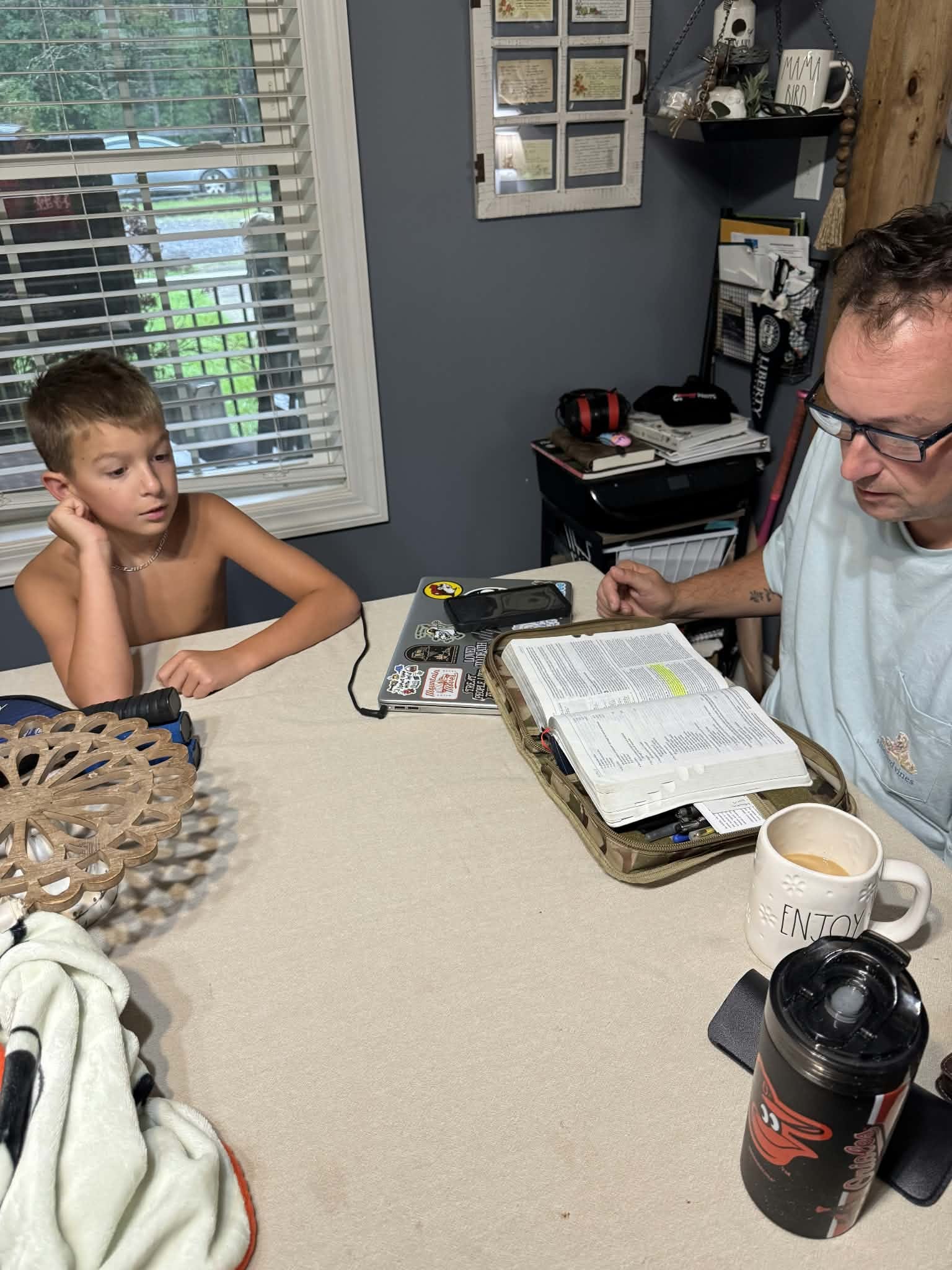
He pulled up beside me during my daily devotion time and asked what I was doing, so I walked him through the chapter. I love opening the Bible with my kids and watching the wheels begin to turn. God’s Word will not return void.
One time a man asked me, “So, are we just going to be in the Bible?”
Yeah, man, we are. That is what it is all about.
In the words of my mentor, “I don’t care what you think. Give me Scripture.”
As Rhett and I read Ezra 3, one detail grabbed my attention. The people had returned to Jerusalem with an enormous amount of work in front of them. There were homes to establish, walls to repair, and a temple to rebuild.
But before they laid the foundation of the temple, they built an altar.
Before they went to work, they worshiped.
That order matters.
“Despite their fear of the peoples around them, they built the altar on its foundation and sacrificed burnt offerings on it to the Lord, both the morning and evening sacrifices.”
Ezra 3:3
“On the first day of the seventh month they began to offer burnt offerings to the Lord, though the foundation of the Lord’s temple had not yet been laid.”
Ezra 3:6
What does a man build first when everything around him needs rebuilding?
When the people of Israel returned to Jerusalem, almost everything needed attention. The city had been destroyed. The temple had been reduced to rubble. The walls were broken down, and the people were surrounded by those who did not want to see Jerusalem restored.
There was no shortage of work to do. Yet the first thing they built was not a wall, a house, or even the foundation of the temple.
They built an altar.
In Ezra 1, God stirred the hearts of His people and called them to rise. In Ezra 2, they arrived in Jerusalem and gave according to their ability toward the work. But before the temple could be rebuilt, something had to happen within the people rebuilding it.
Their relationship with God had to come first.
Before there was a foundation, there was an altar.
The altar represented sacrifice, forgiveness, worship, and surrender. It reminded the people that their greatest problem was not the condition of Jerusalem. Their greatest problem was the condition of their hearts. A rebuilt city without a restored relationship with God would only produce better-looking ruins.
The same is true for us.
In the last part of this series, we discovered that the temple needing to be rebuilt is not only something around us. The rebuilding must begin within the man himself. Our marriages, families, churches, and communities need faithful men, but a man cannot rebuild what is around him while ignoring what is broken within him.
That brings us to the deeper question of Ezra 3:
If the offering is you, have you actually placed yourself on the altar?
Part 2 was about giving according to our ability, but God’s final claim on a man is not ten percent. He wants the whole man. He wants our strength, ambition, influence, time, money, relationships, desires, fears, and plans. He even wants the rooms in our hearts that we have kept locked and hidden.
Romans 12:1 says, “Offer your bodies as a living sacrifice, holy and pleasing to God. This is your true and proper worship.”
We are not offering ourselves to pay for our sins. Jesus Christ, the Lamb of God, made the final sacrifice for sin once and for all. We come to the altar because mercy has already been given. We surrender our lives in response to what Christ has done for us.
A man cannot lead anyone toward an altar he refuses to approach himself.
We often try to reverse God’s order. We want to build the career, establish the reputation, fix the marriage, grow the ministry, discipline the children, improve the finances, and create the life we imagined. Then we ask God to bless what we have built.
Ezra 3 shows us another way.
Before God rebuilds through a man, He begins rebuilding the man.
The people built the altar “in accordance with what is written in the Law of Moses.” They did not worship according to their preferences, feelings, or surrounding culture. They returned to the Word of God and followed what God had commanded.
The ignorance we discussed earlier in this series cannot be corrected by good intentions alone. A man may sincerely want to lead his family and still have no idea how to do it. That is why Scripture must become his blueprint. He must open God’s Word, learn from mature men, and allow God’s truth to correct what the culture, his childhood, and his own desires have taught him.
A man cannot become who God created him to be while allowing the culture to define manhood for him. The world tells him that manhood is found in money, control, achievement, sexual conquest, independence, physical strength, or the ability to hide emotion.
God’s Word gives us a different definition.
BetterMan has taught us that a real man rejects passivity, accepts responsibility, leads courageously, and expects the greater reward that comes from God. He does not build his life around what is popular. He courageously follows God’s Word.
Sincerity is not a substitute for obedience. A man may mean well and still be building according to the wrong blueprint.
Ezra 3:3 also tells us that the people built the altar despite their fear of the surrounding nations.
They were afraid, but they obeyed.
We often imagine courage as the absence of fear. Scripture repeatedly presents courage as obedience while fear is still present. The people did not wait until the threats disappeared. They did not wait until they felt safe. They built the altar while surrounded by people who opposed them.
That speaks directly to men.
You may be afraid of what will happen if you tell the truth. You may be afraid to admit that you need help. You may fear apologizing to your wife because you do not know how she will respond. You may fear confronting a pattern in your home, confessing a secret sin, asking another man for accountability, or taking responsibility for something you have avoided.
Courage does not mean you are no longer afraid. Courage means fear no longer makes your decisions.
The altar became more important than their feeling of safety. One commentator observed that ruined Jerusalem was better guarded by an altar than it would have been by rebuilt walls. Their greatest security was not their defenses. It was the presence and favor of God.
Men spend much of their lives building walls. We build financial walls, emotional walls, reputational walls, and walls of control. We believe that if we can earn enough, plan enough, hide enough, or appear strong enough, nothing will be able to hurt us.
But walls cannot restore a man’s soul.
Only God can do that.
Ezra also tells us that the people offered sacrifices both morning and evening. The altar was not built as a symbol and then abandoned. It was used daily.
Matthew Henry wrote, “Let not those that have an altar starve it.”
An unused altar is only furniture.
Surrender is not a one-time emotional experience at a conference, retreat, or Sunday service. It is a daily way of living. Every morning, a man must decide who will lead his life. Every evening, he must be willing to examine where he followed God, where he failed, and what must be confessed.
The altar reaches into the ordinary parts of life. It affects how a man speaks to his wife, responds to his children, handles his money, uses his phone, conducts his business, controls his anger, fights temptation, and treats people who cannot do anything for him.
God is not asking for a version of you that only appears at church. He wants the man who shows up on an ordinary Tuesday evening when you are tired, frustrated, and no one is watching.
Your family does not need you to pretend to be a perfect man. They need a surrendered man who keeps returning to God.
After the altar was established, the work moved forward. The people gave money to the masons and carpenters. They gathered materials and brought cedar logs for the temple.
Worship did not replace the work. Worship put the work in its proper order.
Prayer should produce obedience. Surrender should lead to responsibility. Worship should eventually result in work.
A man who has truly met with God cannot remain unchanged forever. At some point he must make the phone call, have the conversation, begin the discipline, remove the temptation, keep the promise, or lay the first stone.
When the foundation of the temple was finally laid, the people praised God, shouting, “He is good; his love toward Israel endures forever.”
But not everyone shouted.
Some of the older men who had seen Solomon’s temple began to weep. They remembered what had once stood in that place. They remembered the former glory, and the new foundation probably looked small in comparison. The younger generation shouted for joy while the older generation wept over what had been lost. The sounds became so mixed that no one could distinguish the shouting from the crying.
That picture is remarkably honest.
Rebuilding often contains both grief and joy. You may rejoice over the work God is beginning while grieving the years that were lost. You may be thankful that your marriage is healing while wishing you had sought help sooner. You may begin connecting with your children while grieving the moments you missed. You may celebrate freedom from sin while mourning the damage it caused.
God does not condemn those tears. But grief over yesterday must not cause us to despise what God is beginning today.
You cannot rebuild yesterday’s temple. You can only be faithful with the foundation God has placed in front of you now.
A mature man can grieve what has been lost without despising what God is beginning.
Zechariah 4:10 asks, “Who dares despise the day of small things?”
The first stone may not look impressive. Fifteen minutes of Scripture may not feel life-changing. One honest conversation may not repair a marriage. One evening with your child may not erase years of distance. One confession may not immediately restore trust.
But temples are rebuilt one stone at a time.
Start with the altar.
Open God’s Word before opening your phone. Pray before entering the day. Tell God what you are afraid of. Confess what you have hidden. Ask a mature man to walk with you. Obey the next thing God has already shown you to do.
Stop waiting until you feel completely rebuilt before you worship.
Worship is where the rebuilding begins.
In Ezra 1, God stirred the man.
In Ezra 2, the man brought what he had.
In Ezra 3, the man placed himself on the altar and began laying the foundation.
So the question is not whether everything in your life has already been repaired. The question is:
Is there an active altar in your life, and what is God asking you to place on it today?
The altar went up. The foundation went down. The sound of worship could be heard from far away.
Then the opposition arrived.
The ruins had stood undisturbed for decades, but once the people began rebuilding, resistance followed.
More on this next time.