Be Stihl and Know
Theology from a Woodcutter

Yesterday, while pricing the removal of several gigantic white oaks, it occurred to me that I had forgotten a major event in the life of a brother. I told him I had missed the forest for the trees. But maybe it was the tree, and the presence of the Holy Spirit, that reminded me. It would not be the first time God met a man under an oak and showed him something.
I find the relationship between God, man, and trees fascinating. Trees appear simple, and yet they are vastly complex and necessary for life. Much like man. In a way that almost reflects God. We are ourselves a kind of small trinity, body, soul, and spirit, integrated and living.
When I retired from the Army ten years ago, several people asked what I planned to do next. I told them I intended to work on trees. They looked at me like I had lost my mind. But if I am honest, a career at war had clarified something in me. A simple life working with my hands, sleeping in my own bed beside the woman I love, raising children in the Lord, felt like a little piece of heaven.
Ten years later I can testify that I am closer to the Lord, and the path He led me onto was indeed the narrow one He intended. I come home most days covered in sawdust, smelling like pine, maple, oak, diesel, and two-stroke gas, a mixture my children now associate with me. Ava, my third daughter, used to say, “You smell like trees.” I always laughed.
It is my prayer that one day they say something more.
“You smell like Jesus.”
A simple man who worked with His hands. Who loves His children. Who went to work on a tree and made things right again. And when His work was finished, He rose to heaven and prepares a place for me.
The chainsaw screams and oak fibers tear. Rings split open like years exposed. You learn something about trees when you cut them. Strength is not bark. Height is not life. The secret is always below. Roots decide everything.
Scripture has always said the same about men.
The Bible’s tree anthropology
The Bible opens with a man among trees. God forms Adam from the ground and places him in a garden, a living system of rooted things drawing life from unseen sources. At the center stand two trees, life and knowledge. Human destiny turns on wood.
From the beginning, God teaches man who he is by where he lives. Among trees, dependent, planted, sustained. So when Scripture later describes the righteous man, it reaches for the same image. “He is like a tree planted by streams of water, which yields its fruit in season and whose leaf does not wither.” Psalm 1:3
Jeremiah repeats the picture. The prophets expand it. Jesus seals it. “Every good tree bears good fruit.” Matthew 7:17
This is not poetic flourish. It is anthropology. Rooted creature. Growing creature. Fruit bearing creature.
And when humanity falls, it falls again by a tree. When redemption comes, it comes on a tree. “He himself bore our sins in his body on the tree.” 1 Peter 2:24
The story closes where it began, a river and a tree of life whose leaves heal nations. Creation, fall, cross, new creation, all told in timber.
The Testing Tree, where God meets and proves men
In Scripture, trees are not background scenery. They are meeting grounds, decision points, places where God confronts man and something in him is revealed. Wood becomes the medium of testing.
The first human test stands beneath branches. One tree withheld. One boundary given. One obedience required. Human history fractures at a trunk.
After the flood, humanity is preserved inside trees. An ark of cut timber carries life through judgment. Salvation itself floats in wood.
Then a bush burns without consuming. Moses turns aside, and a shepherd becomes a prophet. A life pivots because a man stops before a tree filled with God.
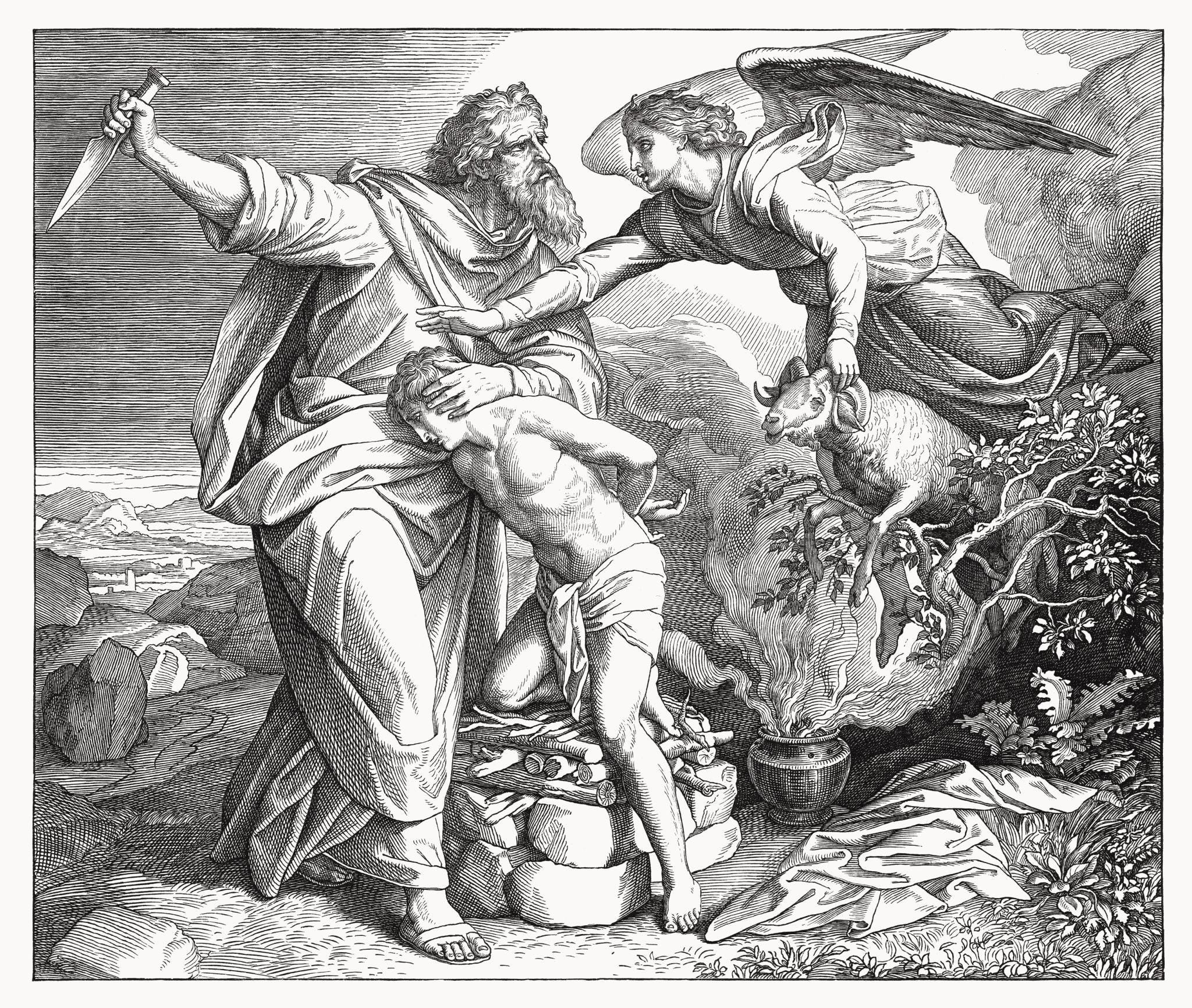
Abraham climbs a mountain with his son and wood on his back. Faith is tested on stacked branches. Provision appears beside a thicket. Trust is proven at timber.
Zacchaeus climbs a sycamore to see Jesus. Elevation precedes repentance. A man changes because he went up a tree to glimpse the Lord passing by.
And finally, the Son of Man is lifted onto wood again. The last Adam tested on the last tree. Obedience held where the first failed.
Trees in Scripture mark thresholds. Will you trust. Will you obey. Will you turn aside. Will you surrender. Every major covenant movement brushes bark.
Which means the question of roots is never abstract. God tests men at the level of attachment. What you cling to. What you will not release. Where you stand when commanded to move.
The tree exposes allegiance.
In Eden, man grasped.
On Moriah, Abraham released.
At Calvary, Christ obeyed.
Wood becomes the axis of decision.
Restless men in a rootless age
We live in the first civilization of uprooted men. We relocate without mourning. Change callings without covenant. Consume places instead of inhabiting them. Our fathers stayed. We drift.
The ancient world measured a man by what he cultivated, land, household, vine, name. We measure men by velocity, reach, scale, output.
But souls do not grow fast. Trees do not hurry. Roots do not perform. So we have built a culture of visible canopy and hidden decay. Men impressive above ground and hollow below it. Platform without depth. Leaves without rings.
Scripture calls the wicked chaff, weightless and blown by wind. Modern life has industrialized the process. Notifications pull. Opportunities scatter. Comparison uproots.
And beneath the noise, the psalmist still speaks with agrarian clarity. “Be still, and know that I am God.” Psalm 46:10
Stillness here is not passivity. It is settledness. The quiet refusal to move when winds shift. The strength of roots gripping earth beneath frost.
The modern crisis of men is not mainly rebellion. It is dislocation. We are not planted long enough to become strong.
How a man becomes a tree
Trees grow by downward commitment before upward expansion. No tree strains toward height. It sinks first. Depth precedes stature.
Trees grow in two methods, primary and secondary growth. Primary growth in trees is vertical growth. It occurs at the tips of shoots and roots, called apical meristems. This is what makes a tree taller and extends its branches and roots outward each growing season.
Secondary growth is thickening growth. It occurs in the vascular cambium, a thin layer beneath the bark. This produces new wood (xylem) inward and new bark (phloem) outward, increasing the tree’s diameter and forming annual rings.
In short, primary growth adds length, secondary growth adds girth.
So if Scripture calls the righteous man a tree, the path is not mystical. It is agricultural.
A man roots by abiding. Same God. Same Word. Same church. Same vows. Same obedience. Year after year.
We want fruit without rooting. But fruit is stored sunlight, years of it condensed. You are tasting seasons you cannot see.
A man becomes stable by returning when nothing feels new. Return to prayer when it feels dry. Return to Scripture when it feels silent. Return to gathered worship when it feels ordinary. Return to covenant when it feels costly.
Roots form in repetition. Storms do not build trees. Seasons do.
So the call is not heroic. It is stubborn. Plant where grace flows. Stay when boredom comes. Sink when culture drifts. Trust the ancient promise. The one planted by streams of water will bear fruit in season. Not constantly. Not quickly. But certainly.
Be Stihl and know
The chainsaw teaches what the forest already knew. Strength lives underground. Years hide beneath bark. Stillness is not weakness. It is anchoring.
“Be still, and know that I am God.” Psalm 46:10
Stillness is settled allegiance. A man refusing to be uprooted from the God who planted him.
So plant yourself. In Scripture deeper than opinion. In prayer longer than mood. In church beyond preference. In covenant past ease.
Become the kind of man storms cannot relocate.
The world has enough driftwood. God is growing oaks.
Be still. Be planted. Be Stihl and know.
From one arborist to another, thanks for this post
Beautiful! Thank-you!❤️